What Is Cooking Technology? A Guide for Air Fryers Buyers (2026)
As an Amazon Associate we earn from qualifying purchases. Links on this page are affiliate links.
Cooking Technology Explained for Buyers
Understanding cooking technology explained helps you choose the right appliance. Air fryers and multi-cookers use different methods to heat food. Three common types are induction heating, micom, and fuzzy logic. Each offers distinct benefits for your kitchen routine.
Induction heating uses electromagnetic fields to heat the cooking pot directly. This method is fast and efficient. It transfers energy with minimal loss. You get rapid preheating times. The temperature control is precise. This technology is common in high-end multi-cookers. It ensures even heat distribution across the bottom of the pot.
Micom stands for microcomputer. It uses a simple chip to control temperature and time. The device follows preset programs. You select a setting, and the chip manages the rest. This is reliable and straightforward. It is found in many standard air fryers. The control is binary or limited step-based. It does not adjust continuously based on internal conditions.
Fuzzy logic is more advanced. It mimics human decision-making. The sensor checks the temperature and adjusts power in real time. It does not just follow a fixed script. It responds to changes in the food. This leads to more consistent results. You avoid overcooking or undercooking. This technology is often in premium models. It handles complex cooking tasks better than basic micom.
When you shop, look for these terms in the specifications. Induction heating suggests speed and precision. Micom indicates basic automated control. Fuzzy logic points to adaptive cooking. Knowing the difference helps you match the device to your needs. You do not need the most complex tech for simple tasks. But for delicate foods, fuzzy logic offers an edge. Check the product details to see which system is used. This knowledge simplifies your buying decision.
Compare Cooking Technologies
Induction Heating
This method uses magnetic fields to heat the cookware directly. You get fast heat recovery and precise temperature control. It works best with compatible pots. For example, the Cuomaop Stainless Steel Frying Pot offers manual control for those who prefer handling heat themselves. The Oster Beauford 4-Quart model provides durable stainless steel construction for versatile stovetop use. High-volume options like the EGGKITPO 25.4 QT unit suit commercial kitchens needing 240V power. The trade-off is you must own induction-compatible cookware. It does not include automated digital programs. You manage the cooking process manually. This suits cooks who value direct heat management over convenience features.
Micom
Micom technology uses a microcomputer to control cooking parameters. It reads sensor data to adjust heat and time automatically. This creates consistent results without constant monitoring. You do not need to guess settings. The appliance handles the variables for you. This is ideal for beginners who want reliable outcomes. It simplifies the cooking process significantly. You can set it and forget it for many tasks. The trade-off is less manual control over the cooking curve. You cannot easily tweak the heat during the cycle. It relies on pre-programmed settings. This suits busy households needing predictable meals. It reduces the skill gap for complex dishes. You get consistency every time you use it.
Fuzzy Logic
Fuzzy logic uses algorithms to adjust cooking variables in real time. It mimics human decision-making by making small adjustments. The system learns from sensor feedback during the cycle. This leads to more nuanced control than standard timers. You get better texture and doneness for varied foods. It handles ingredient differences automatically. This suits cooks who want precision without manual effort. The trade-off is higher complexity and cost. You may find fewer models available. It can be harder to understand than simple dials. You rely on the machine's internal logic. This is best for those who prioritize food quality. It adapts to changes in load or temperature automatically.
Who Needs These Cooking Techs
Who needs it
Buyers seeking precision should prioritize models with micom and fuzzy logic. These technologies work together to adjust cooking parameters in real time. You get consistent results without constant monitoring. The appliance learns from your habits and the specific food type. This is ideal if you cook varied meals daily. You want crispy fries one day and steamed vegetables the next. Fuzzy logic handles the complexity so you do not. You save time and reduce guesswork. Induction heating adds another layer of control. It heats the pot directly for faster response. This matters if you sear or sauté often. You want immediate temperature changes. The combination offers professional-level consistency at home. You value repeatability. You dislike burnt or undercooked food. These specs ensure every batch matches the last. You are willing to pay for advanced control. You want the appliance to manage the details. This setup suits busy households. You need reliable performance. You trust data over intuition. These features remove the error from cooking. You get better outcomes with less effort. This is for those who view cooking as a science.
Who can skip it
Casual cooks can ignore these advanced specs. You do not need micom or fuzzy logic for simple tasks. Basic timers and manual controls suffice for most everyday meals. You can manage temperature with a dial. You prefer simplicity over automation. Advanced features add cost without adding value for you. You cook the same meals repeatedly. You like to experiment with your own methods. You do not mind checking food manually. Prioritize capacity and ease of cleaning instead. You want a straightforward interface. You do not want to read a manual. Basic models offer enough power for air frying. You value transparency. You want to see exactly what settings you use. Complex logic hides the process. You prefer direct control. You cook infrequently. The investment in advanced tech is unnecessary for you. Stick to standard multi-cookers. You save money for better accessories. You want a tool that does not think for you. You trust your own senses. Simple is better for your routine. You do not need precision for basic roasting. Skip the tech. Focus on size and durability.
Cooking Tech Glossary
Cooking Functions
Specific modes like bake, air fry, or roast. These determine how heat circulates. You select a function based on the food you prepare, ensuring the appliance applies the correct heat pattern for optimal results.
Special Features
Extra capabilities such as keep-warm or preheat indicators. These add convenience to your routine. They allow you to manage timing better without needing to monitor the appliance constantly during the cooking process.
Control Type
How you interact with the device, such as buttons or a digital touch panel. Digital controls often offer precise time and temperature settings. Knobs provide a more traditional, manual adjustment experience for simple tasks.
Wattage
The power consumption of the unit, measured in watts. Higher wattage typically means faster heating and cooking times. You should check this spec to ensure your kitchen circuit can handle the appliance safely.
Recommended Use
The intended purpose, such as single-serve or family-sized cooking. This guides you on capacity. A compact unit suits one person, while a larger multi-cooker handles batch cooking for several people efficiently.
Cooking Technology
The method used to generate heat, like induction or traditional resistance heating. Induction heats the pot directly for speed. Resistance heats an element that warms the air, which is common in standard air fryers.
Pot Material
The substance of the inner vessel, often stainless steel or non-stick coated aluminum. This affects heat distribution and cleaning. Stainless steel is durable, while non-stick coatings make releasing food and washing easier.
Size
The internal capacity, usually measured in quarts or liters. This determines how much food fits inside. You choose a size based on your household needs, ensuring you can cook your typical meal portions.
Quick picks
| # | Product | Best for | Price |
|---|---|---|---|
| 1 | Cuomaop Stainless Steel Frying Pot with Thermometer | induction-compatible manual frying | Check price of Cuomaop Stainless Steel Frying Pot with Thermometer on Amazon |
| 2 | Oster Beauford 4-Quart Stainless Steel Fryer Pot | Induction heating and versatile stovetop use | Check price of Oster Beauford 4-Quart Stainless Steel Fryer Pot on Amazon |
| 3 | EGGKITPO 25.4 QT Induction Fryer | High-volume commercial kitchens with 240V power | Check price of EGGKITPO 25.4 QT Induction Fryer on Amazon |
Our 3 picks
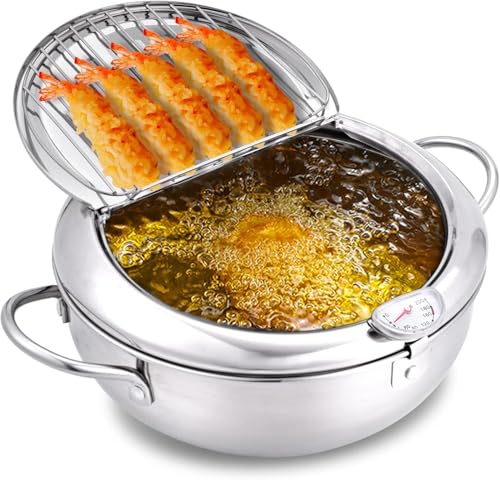
Cuomaop Stainless Steel Frying Pot with Thermometer
Best for: induction-compatible manual frying
- Cooking Technology
- Induction Heating (what this guide is about)
- Pot Material
- 304 Stainless Steel
- Special Features
- Temperature Control
- Dimensions
- 3.94 × 0.79 × 1.06 inches
- Weight
- 2.57 pounds
View on Amazon: Cuomaop Stainless Steel Frying Pot with Thermometer Affiliate link
This Cuomaop deep fryer pot is a 304 stainless steel vessel designed for precise oil frying. It features induction heating compatibility, allowing it to work on various cooktops including gas and electric. The unit includes a temperature gauge for monitoring oil heat and a beak spout for safe drainage. Its 9.8-inch diameter offers a compact footprint for smaller kitchens. You get a mirror-polished interior that simplifies cleaning after use.
Pros
- Constructed from durable 304 stainless steel
- Compatible with induction, gas, and electric cooktops
- Includes a temperature gauge for precise heat monitoring
- Features a beak diversion spout for safe oil drainage
Cons
- Compact 9.8-inch diameter limits batch cooking capacity
- Requires manual temperature monitoring via gauge without digital controls
- Lacks an integrated timer for automatic shut-off
Good fit if
- You need a pot compatible with induction cooktops
- You prioritize precise temperature control for frying
- You want a stainless steel vessel that is easy to clean
Skip if
- You require a large capacity for family-sized batches
- You prefer automatic digital timers and temperature displays
- You are looking for a standalone electric appliance
Verdict: Cuomaop 9.8-Inch Induction Deep Fryer Pot suits cooks who need a versatile, induction-compatible pot with manual temperature control. It is ideal for those who value precise heat management and easy drainage over automated features.

Oster Beauford 4-Quart Stainless Steel Fryer Pot
Best for: Induction heating and versatile stovetop use
- Cooking Technology
- Induction Heating (what this guide is about)
- Capacity
- 4 Quarts
- Pot Material
- Stainless steel
- Special Features
- Dishwasher-Safe Parts, Oven Safe
View on Amazon: Oster Beauford 4-Quart Stainless Steel Fryer Pot Affiliate link
This Oster deep fryer pot uses induction heating for even cooking. It holds 4 quarts and features a stainless steel interior that resists acids. The pot works on all stovetops, including induction and gas. You get a basket and glass lid for frying. The rivetless handle simplifies cleaning. It is oven safe and dishwasher safe. This setup suits those who want versatile cookware that heats efficiently on modern ranges.
Pros
- Induction heating technology for even heat distribution
- Compatible with all stovetops including induction and gas
- Non-reactive stainless steel interior prevents metallic taste
- Rivetless soft-touch handle for easier cleaning
Cons
- 4-quart capacity is smaller than commercial 12-liter options
- No automatic temperature control or timer listed
- Requires manual monitoring during the frying process
Good fit if
- You want induction heating for faster, even cooking
- You need cookware compatible with all stovetop types
- You prefer stainless steel for non-reactive cooking
Skip if
- You need a large capacity for commercial batches
- You want an appliance with automatic settings
- You only have a standard electric coil stove
Verdict: Oster Beauford 4-Quart Induction Deep Fryer is a solid choice for home cooks who prioritize induction heating and versatile stovetop compatibility. It fits buyers who want durable stainless steel cookware that handles high heat well without automatic controls.

EGGKITPO 25.4 QT Induction Fryer
Best for: High-volume commercial kitchens with 240V power
- Cooking Technology
- Induction Heating (what this guide is about)
- Capacity
- 25.4 QT
- Pot Material
- 304 Stainless Steel
- Max Temperature
- 374°F
- Wattage
- 7000W
- Special Features
- Timer
View on Amazon: EGGKITPO 25.4 QT Induction Fryer Affiliate link
This commercial unit uses 7000W induction heating for rapid heat recovery. The 25.4-quart stainless steel tank supports high-volume frying. You get precise control from 86°F to 374°F with a 60-minute timer. The large footprint and heavy weight suit busy kitchens. It requires a 240V outlet, which limits where you can place it.
Pros
- 7000W dual-circuit induction heating for fast recovery
- 25.4-quart 304 stainless steel tank capacity
- Precise 86°F to 374°F temperature range
- 60-minute timer with clear end-alert
Cons
- Requires a 240V power outlet
- Weighs 73 pounds
- Large 21-inch width limits placement
Good fit if
- You need rapid oil temperature recovery for high volume
- You have a 240V electrical circuit available
- You require a large 25.4-quart capacity
Skip if
- You only have standard 120V outlets
- You need a compact countertop appliance
- You prioritize portability over capacity
Verdict: EGGKITPO 25.4 QT Induction Fryer delivers serious power for commercial kitchens. It fits operations that need fast recovery and large batches, provided you have the space and 240V power.
Specifications side by side
| Spec | Cuomaop Stainless Steel Frying Pot with Thermometer | Oster Beauford 4-Quart Stainless Steel Fryer Pot | EGGKITPO 25.4 QT Induction Fryer |
|---|---|---|---|
| Capacity | not stated | 4 Quarts | 25.4 QT |
| Pot Material | 304 Stainless Steel | Stainless steel | 304 Stainless Steel |
| Max Temperature | not stated | not stated | 374°F |
| Wattage | not stated | not stated | 7000W |
| Special Features | Temperature Control | Dishwasher-Safe Parts, Oven Safe | Timer |
| Recommended Use | not stated | not stated | Commercial Use |
| Cooking Technology | Induction Heating | Induction Heating | Induction Heating |
| Size | 9.8inch | 4 Quarts | 25.4 QT / 240V |
| Dimensions | 3.94 × 0.79 × 1.06 inches | not stated | 16 × 21 × 18 inches |
| Weight | 2.57 pounds | not stated | 73 pounds |
| Color | ['silver'] | Stainless Steel | Stainless Steel |
| Model | not stated | 147043.03 | EGG-240-FRT2C08B |
Frequently asked questions
How does induction heating work in an air fryer?
Induction heating uses magnetic fields to generate heat directly in the cookware. This method provides fast heat recovery and precise temperature control. You get consistent results without waiting for a heating element to warm up. The Cuomaop Stainless Steel Frying Pot uses this technology for manual temperature management. It suits cooks who want direct heat control over automated settings.
What is the difference between micom and fuzzy logic cooking?
Micom refers to microcomputer-controlled cooking that adjusts parameters based on preset programs. Fuzzy logic adds a layer of intelligence by making real-time adjustments. It learns from your habits and the specific food type. This combination allows for consistent results without constant monitoring. You do not need to guess settings, as the appliance adapts automatically to changing conditions during the cooking process.
Can I use any pot with an induction air fryer?
No, you must use cookware that is compatible with induction heating. The material must be magnetic, such as cast iron or certain stainless steels. The Cuomaop Stainless Steel Frying Pot is designed for this specific requirement. Using incompatible pots will prevent the magnetic field from generating heat. Always check the manufacturer's specifications to ensure your cookware works with induction technology.
Is induction heating better than traditional electric heating?
Induction heating offers faster heat recovery and more precise temperature control. Traditional electric heating relies on a separate element that takes time to warm up and cool down. With induction, the pot itself becomes the heat source. This reduces energy waste and improves responsiveness. The Oster Beauford 4-Quart Fryer Pot highlights these benefits for stovetop use. It handles high heat well without automatic controls.
What size induction fryer do I need for a commercial kitchen?
Commercial kitchens often require high-volume units with significant power output. The EGGKITPO 25.4 QT Induction Fryer is built for serious power and large batches. It requires 240V power and substantial space. You need to ensure your kitchen has the proper electrical infrastructure. This unit delivers fast recovery times for high-demand operations. It fits buyers who prioritize capacity and speed over compact designs.
Do I need an app to control induction cooking technology?
No, induction heating does not require an app for basic operation. Many models, like the Cuomaop Stainless Steel Frying Pot, offer manual temperature control. You adjust settings directly on the device. While some advanced units may offer connectivity, it is not essential for the core technology. The Oster Beauford 4-Quart Fryer Pot also focuses on durable stainless steel construction without relying on digital interfaces for heat generation.